 H
H



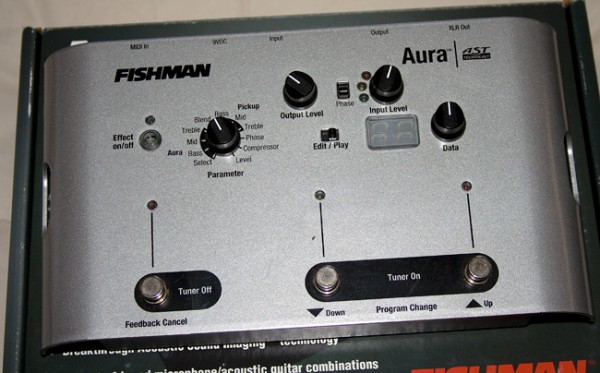
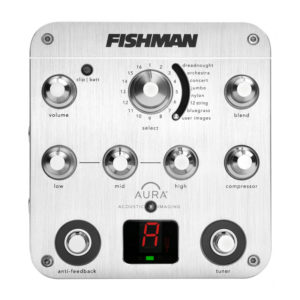
About The Fishman "Aura" TechnologyFishman Transducers has become the leading manufacturer of pickups for acoustic instruments, and they have developed a powerful but confusing technology for amplifying acoustic instruments that I am very happily using on stage. This is a description and hopefully a clear explanation of what it can and can't do. In my opinion, neither the magazine reviews, blogs, nor the web site and literature from Fishman do a proper job of explaining things, which is why I am writing this. HARVEY REID (York, Maine 2008, with some editing and tweaking in 2012) Note added in 2017- I believe that this programmable Aura technology that I use and like is already unavailable:
and the newer "replacement" version does not do all the things mine does.
The Aura files I install in my box are a different type and not compatible with the newer version that is sold, and to get what I have you need to buy a used one on eBay. Welcome to the wonderful world of technology... DISCLAIMER: I do know Larry Fishman, and have a long-standing friendship with the company. I have never been on their payroll, and the only money I have ever recieved from them was to do a few in-store workshops trying to explain the Aura amplification system in 2004, and almost 20 years ago they hired me to demonstrate some products in music stores in Europe. I used to play guitar in their booth at trade shows, but have not done that in over 10 years. I will confess to using a number of their products, and being happy with most of them, but I am and have never been an employee or paid consultant. My goal here is to share some of my knowledge about a tool that really can make the life of a performing acoustic musician dramatically better. I understand the issues involved, and I know the ins and outs of these tools, and am trying to share some experience with people who are searching the web for information. The Fishman Aura is a relatively recent technology in acoustic instrument amplification that I consider to be a quantum jump forward in making acoustic instruments sound natural and loud when plugged in. I have used it on stage since 2003. It is a different sort of animal than most processor boxes, and is difficult for people to understand at first. To my ears, as somewhat of an acoustic purist, the signal-processing, EQ and pre-amp technology of the last 20 years has only succeeded in making the marginal and sometimes downright lousy-sounding piezo pickups sound somewhat less lousy. Even quite famous players often have lousy-sounding plugged-in acoustic guitars, and finally that is changing, and I now often hear things I like, after decades of not liking much. I have never heard a pickup sound until recently that I would call "rich" and "lush" or "life-like." The door to a new era has been opened, and though it is only going to get better, the first sound images I have used with the first Aura boxes off the production line have immediately put me into a whole new world of stage sound, and can work just as well for anyone who takes th time to learn to operate and set up the Aura. It is important to mention a couple things up front before I get into the explaining: 1) Using the Aura on stage and using it in a recording project are quite different. On stage it's all about volume before feedback, and the enemy is the "wolf tones" and resonances that cause an acoustic instrument to feed back. You need to use modest settings, and only a few of the settings will sound acceptable. If you are applying the Aura processor to a recorded track to change its tone then you have many more options, since you don't have to worry about feedback, and the acoustic properties of the instrument are never "fighting" the processor. I don't use it or need it in recording situations much, since I just mike my instruments. I will confess that I often plug in my Aura and record a simultaneous direct track when I am recording, and I can sometimes add a little sustain, presence or volume to the mix without losing the "natural sound" of my instrument. It's very helpful on quiet instruments like autoharp, or when I record with someone else playing with me and need to mix my sound with theirs. 2) The part of the Aura technology that I am most excited about is how it can be used and optimized for a specific instrument. Because this is not practical to do on a large scale, and it is hard, the Fishman company has changed its focus in marketing and production, and now they are only selling the new version (Spectrum) a device where you can just plug your instrument in, spin the knobs and hope you find something that sounds good. They started out with a dozen pre-recorded "images" and now the new boxes have hundreds, and enough people are finding something in the pile that is a lot better than what they had, so they are are willing to spend the money for the box. It's now easy to test them in a music store by just plugging your instrument in, and you don't have to remove anything you already own, and just plug & play. The unfortunate thing is that this generates a "bell curve," where most people get something that sounds "pretty good," a smaller group at the "high end" get a "great" sound, and about an equal number at the "bottom" get a sound that is less good. The collaboration they did with Martin is impressive, and the Martin guitar models with the built-in Aura work the same way. Only one guitar has exactly the right sound image, but every one I have heard has been a good sound, and I'd have to say it is the best-sounding onboard system I have ever heard yet. 3) I still use the original, programmable Aura unit that is discontinued at this point in 2012 when am editing this article a little. I am told that Fishman is finally planning later this year to upgrade it and make a new model to replace the bulky old units that many of us still use on stage. None of the new models since the one I use have had the user-saved presets, or the feedback finder notch filter, which is excellent. The music products market is unfortunately not driven by what live performers want and use, and hobbyists and amateurs really determine what is sold on the music store shelves. It apparently was a customer support headache for Fishman to even encourage people with the programmable Auras to go to their web site and try to download and install images from the library there until they found one that worked for them. Now they just load hundreds of them into every box and hope it makes people happy. The bummer is that the technology is good enough to make almost everyone ecstatic, but there is just no way to deliver it to all the customers, and I understand Fishman's position. NOW THE EXPLANATION Long ago I swore that I would never perform without a microphone and that I could never be satisfied with just a pickup, and now I am happily doing just that. I use the Aura onstage with 3 different acoustic guitars, a mandolin, octave mandolin, banjo, autoharp, resonator guitar, and mandocello, and people often come running up after a show to ask me what I am using for sound reinforcement. It is as simple as stepping on a footswitch to jump from one instrument to the another (There are 12 user-created presets that can be stored, in addition to the 10 permanent sond images.), and they all go through the same cord and the same Aura to the PA. The original Aura that I use allows me to save presets with volume, tone, phase and compression, so I can carefully set all my signals where I want them, and just send a flat signal to the soundboard, and all my instruments are the right level. It even has a muting foot-switch, so I can change instruments noiselessly. The Aura is essentially Photoshop for guitars. It was inevitable that computer chips would get small enough, fast enough and cheap enough so you could cram enough firepower into a box that costs $100-300 where it can alter your signal in real-time and improve the sound of your pickup without adding latency and other problems. We have had plug-ins for our recording software for years that crunch the waveforms, and now we can do impressive things while we play. I don't mean to be an acoustic snob, but the signal coming out of an electric guitar is a much simpler thing than what comes out of an acoustic, and even the piezo signal from an acoustic pickup has a lot more complexity than a magnetic pickup signal from a Telecaster. Electric guitar amps don't even have tweeters-- there is nothing much above 6k in terms of frequency to deal with and there are no issues with phase, which is a huge issue with the vibrating tops and bodies of acoustic guitars on stage. Stomp boxes made for electric guitars often sound pretty bad when you plug an acoustic into them, and Fishman has done a great job the last few years of remaking reverb, compressors and pre-amps optimized for the more complex acoustic signals. Most of the signal-processing boxes out there were designed for electric guitar, and the Aura system is one of only a handful that were made from the ground up to work with plugged-in acoustic instruments. It willingly embraces all the quirks, complexities and resonances of acoustic guitars, which have proven to be remarkably hard to amplify. The Aura at a glance appears to be similar to what is called "modeling" technology, but is quite a different approach and there is more going on. Modeling grew out of electric guitars, and the way it works does not apply that well to acoustic guitars. The playing field of acoustic guitar is not at all like electric guitars, where the body of the guitar is quite inert; the pickups are sensing only the strings, and thus behave very much like other guitars of the same brand when you plug them into amps and effects. If 30 people all plug their Fender Telecasters into Twin Reverb amps, a very similar sound will result. If 30 people all plug their Martin D-28's with a Matrix under-saddle pickup into a PA system, their sounds will be quite different from each other, and this is the essence of the problem. The modeling pre-amps are just fancy EQ boxes that store information about what a particular amp does to a signal that goes into it. This information is obtained from measuring the sound waves that come out of the amp. It works because the starting point is the same for all the guitar signals, and because the signal contains only string information, and there are no guitar body resonances and phase issues to interfere. Acoustic guitars, even if they are the same brand and model, are quite different from each other, and the pickups will most likely behave differently from each other even if they are the same brand, which adds two new levels of variation that will mean that doing the same processing to signals from 30 different acoustic guitar pickups will yield wildly variant final results. When I plug my guitar with my pickup into a "modeling" pre-amp, what I have heard sounds quite confused and unnatural, and I have not liked what I have heard from the ones I have tried. When you are on-stage with a vibrating and resonating acoustic guitar, no modeling technology I have heard delivers the full-bodied, lifelike sound I am after, and the Aura does. The Aura takes a different approach. Ideally, you plug your guitar pickup into a recording studio, and simultaneously mike the guitar, and record something that generates 2 different soundwaves, one from the pickup and one from the mike. Fishman's computer can then apply this information that tells it how the pickup signal differs from what a miked sound of that guitar would be, and apply it to the pickup signal. It has a lot of sound-shaping power-- over 2000 parametic EQ's (among other things) and it has enough processing power to modify your pickup signal in real time, while you are playing, into something that sounds dramatically more like your instrument than your pickup does. Because a plugged-in guitar in a performing situation is very alive and resonant, the way it works must be very specific. It does not make a Martin sound like a Taylor. It can really only make your guitar sound more like itself. It works by simply by plugging your pickup into a box. And there's a switch to bypass it, so you and your listeners can instantly A-B the Aura and hear the Before and After. It makes cynical non-believers shake their heads, and I can name you a pretty long list of people who have bought one within days or even hours after hearing mine. The Aura does not contain the sound of your guitar or the pickup-- it contains information that represents the difference between what your guitar pickup and what a mike in front of that guitar sound like. If you make an Aura image from your guitar, it can possibly sound great with another guitar if that guitar has a similar difference between what its mike and pickup signals sound like. This is a little confusing at first to understand. I have made an Aura image for my banjo pickup, and it makes it sound a lot like my banjo. If I plug my guitar into that, it does not make the guitar sound like a banjo. It just applies the same information that works for the banjo pickup- banjo mike transformation, and the end result when you play a guitar through is pretty awful and un-banjo-like. For people who have seen synthesizers turn an electric guitar into a pipe organ or a flute sound, one would think the Aura could make your acoustic guitar sound like something quite different. Because the body of the guitar and the top are alive and vibrating, their resonances clash with the electronically altered signals and with the sound coming from the speaker, and wolf tones and a lot of feedback usually result when you play through the wrong Aura patch. I'll say it again: the Aura image contains information that represents the difference between what a mike and a pickup sound like on a given instrument. They call it a "transformation algorithm." The "images" they load into their boxes and that you can download from their web site are all made by a person in their shop who is playing a particular instrument, with a particular pickup installed in it, and a particular mike is used at a particular distance from the instrument. They make a bunch of the images with all sorts of guitars, pickups and mikes, and then plug a bunch of instruments into them and see what they like, and they make some kinds of decisions as to which ones to load into the boxes and which ones to toss. Ideally the Aura can be "taught" what your instrument and your pickup sound like and then can "morph" the pickup waveform into something that resembles the mike waveform. The end result is of course dependent on what guitar was use to make the sound image you are using to enhance your sound, how it differs from the guitar you will use to play back with, how you input this information about the guitar, which includes your choice of mikes, playing and miking techniques. Those of us who use the Aura are still experimenting, and steadily improving the final sound that comes out of the speakers. The Aura uses specific sound images made from individual guitars, rather than inspecific models that generalize and say certain brands or shapes of guitars have certain tonal properties. To make such a custom image, you must record a sound sample with your guitar and pickup and a mike simultaneously, and send it to Fishman, they can make a midi file which is then installed into the Aura box with a computer and a midi connection and a free downloadable program available on their web site at www.Fishman.com. This is not easy to do currently, and it is something you can only do with help from someone who knows how to do it. The Aura is sold as a guitar device, but I am using it very effectively with autoharp, banjo, mandolin, bouzouki, mandocello, and resonator guitar, and my wife gets a spectacular sound from her viola and violins, and it seems to work equivalently with all of them. 12 of the 16 sound images in the original Aura can be user-programmed, and their web site contains many downloadable files that you can install into your Aura even if you can't yet make the custom files from your individual instruments. The Aura technology is designed to use with a saddle-style piezo pickup, and has significantly less effectiveness with a magnetic, body-mount or bridge-plate pickup. Since it is just a box you plug into, there is no need to get rid of anything you already have, and it is as easy as plugging into it and playing once you have set up the parameters and loaded or selected the sound images. It has volume and tone controls, a bypass switch & mute switch, a built-in tuner, compressors and direct box, so it is a self-contained unit. It is pretty heavy as stomp-boxes go, sits on the floor, and is designed to operate with footswiches. It is somewhat awkward to operate its knobs on the floor, and will need some refinement of its interface before it is perfect, but for a first generation new technology it really works well. The Aura technology, surprisingly, is not confused by playing fast or hard or percussively or bending strings, playing slide etc. The most percussive styles of playing such as hard-driving flatpicking or string-snapping blues have always been the hardest ones to capture with a pickup, even though they are the loudest sounds in the living room or over a mike. The Aura does an amazing job with them, and I am now performing with styles of playing I had stopped using on stage because they amplified so poorly. After using a "Blender" stage set-up for the last 15 years, combining a pickup with an on-board mini-mike on the instrument, I was always pretty happy with it, though when you need to get louder, you have to mix in increasing amounts of the less-musical pickup. The mini mike also causes more feedback problems, and is quite sensitive to wind noise in outdoor gigs. Rather than ship you an empty box and expect you to make your own presets, Fishman installs 16 different sound images that were made with a variety of guitars, pickups and mikes. They are a nice collection of images spanning a wide range of instruments, pickups and mikes, and they also have made available a larger number of downloadable presets on their web site that you can experiment with and load into the Aura with the free utility they offer on their web site. (You also need a computer, an internet connection, a $30 USB-to-MIDI connector box and a MIDI cable.) It is a crapshoot whether or not one of these will be good for your guitar, and actually unlikely that any of them will be perfect. Every time I have tried, there has been at least one preset that sounded quite nice on a random guitar, and it is quite possible that you could be completely happy with one of them; I know several people who are very happily performing with installed pre-set sound images. I have two guitars, however, of the same brand and model, with the same pickups in them, and the sound image I made for each of them sounds unacceptable when played through the one made for the other. I have a friend with the same make and model guitar and pickup, and their guitar did not sound great with either sound image I had made for both my "matching" guitars. It is a very individual thing. If you take the time to make a special one for your guitar & pickup combination, the result can be downright astonishing, and I urge anyone who gets an Aura box to do this, even though it is somewhat tricky to do. The problems of performing live with the Aura are much larger than those of recording, since an acoustic guitar will feed back when it is near a live speaker, and if the resonances are excessive they can cause things to sound strange. You need to experiment a lot with the EQ, phase, and above all the relative mix of the pickup signal and the Aura-modified one, and the combinations you choose will be quite different for performing vs. recording. I have made test recordings where I recorded simultaneously with both the pickup and Aura system, and with a nice mike in front of the guitar, to compare the two sounds. Even when using a guitar of mine where I never liked the pickup at all, I was able to make a recording, where it is virtually impossible to tell the difference between the track recorded with the mike and the one recorded with the Aura. It is literally that powerful a device. It also has the power to make a mess of your sound if you have the presets and the knobs in the wrong place, and the whole thing requires a great deal of care and patience. And finally, I assure you that I am not deluding myself or jumping to sudden conclusions; I have done months of experimenting. I have set up 2 entire systems on stage at concerts, so I could switch back to my old setup instantly if I didn't like something, and I have spent hundreds of hours refining my use of the Aura, and compared it in all sorts of gig situations, and recorded shows to compare sounds. When I played at the Club Lingerie in Hollywood, which has the biggest PA I have ever played through indoors, the sound man came running out of the booth to tell me that that was the best acoustic guitar sound he had ever heard in 20 years. (And that was after him not liking me very much because I was not using his DI boxes or his mikes, etc.) I am not being paid to use the Aura, or to say good things about it. The acoustic music world very much needs to get louder and to sound better, and this technology is the first real breakthrough I have seen in over 20 years, and I feel that the world of acoustic music will be greatly improved by the use of this and subsequent technologies. HARVEY REID
WOODPECKER MULTIMEDIA
|